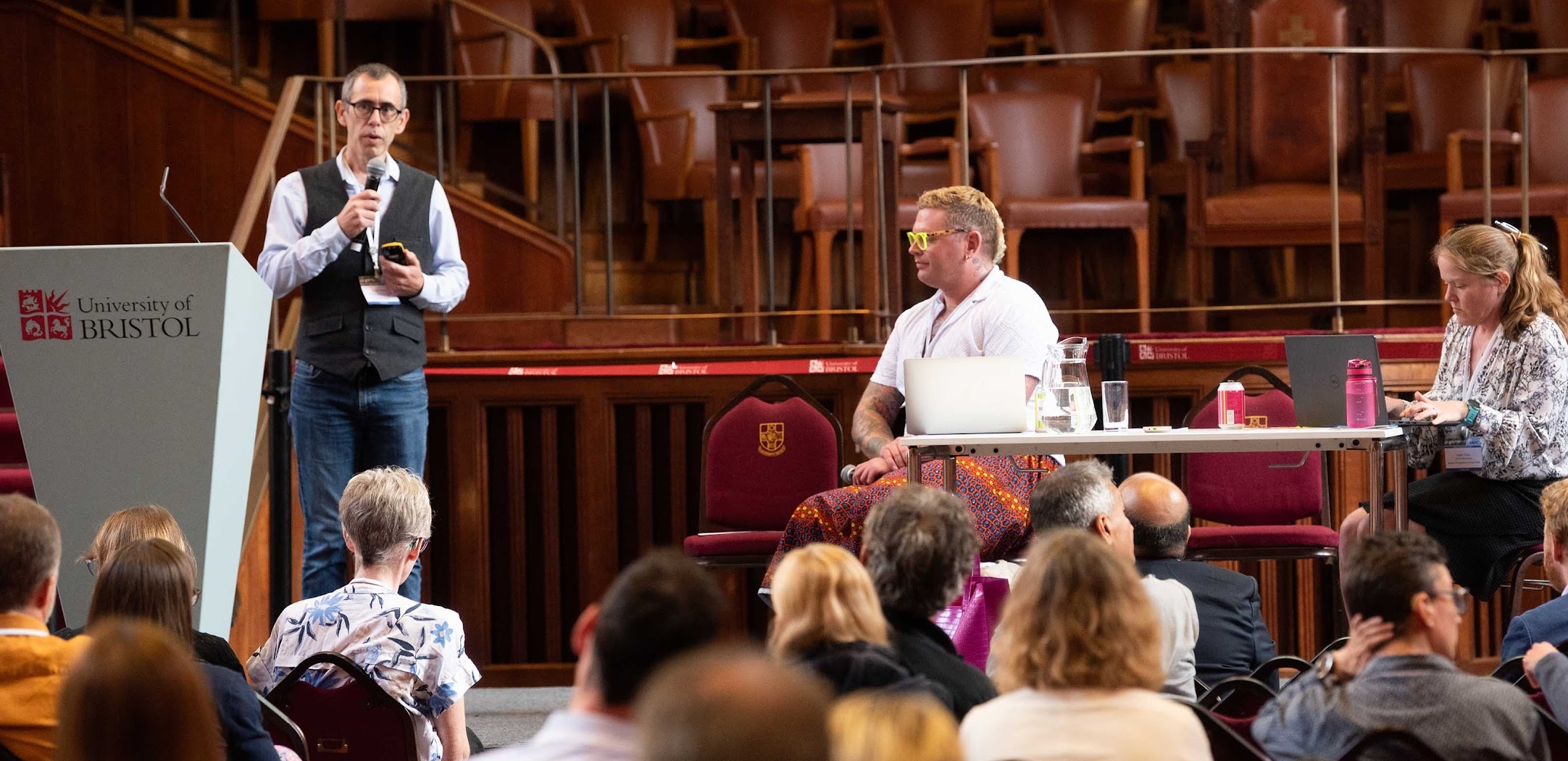
Conference template
54th Annual Scientific Meeting
24-26 June 2026 St Andrews

Conference Overview
Join us for the 54th Annual Scientific Meeting in the historic city of St Andrews. This year's conference brings together leading researchers, educators, and practitioners from across the UK and beyond to share cutting-edge research and innovations in academic primary care.
The three-day event features keynote presentations, research symposiums, poster sessions, and networking opportunities designed to advance the field of academic primary care and foster meaningful collaborations.
Conference Themes
Digital Health Innovation
Exploring technology's role in transforming primary care delivery
Health Equity & Access
Addressing disparities in primary care outcomes
Digital Health Innovation
Exploring technology's role in transforming primary care delivery
Health Equity & Access
Addressing disparities in primary care outcomes
Quick Facts
| Date: | 24-26 June 2026 |
| Location: | St Andrews |
| Expected Attendees: | 500+ |
| Registration: | Opens Feb 2026 |
| Submission Deadline: | 23rd January 2026 |
Early Bird Registration
Save 25% when you register before April 1st, 2026
2026 Call for abstracts
The annual SAPC conference showcases the latest research and education in academic primary care.
Submission deadline 23rd January 2026.
We invite you to submit work in the following formats
Oral presentation
Full oral presentation - 10 minute presentation, 5 minute discussion
Lightning presentation - 3 minute presentation, 2 minute discussion (maximum 3 slides)
Oral and Lightning presentation format: PowerPoint widescreen 16:9 Landscape
Work in progress - the Scientific Programme Committee will consider work in progress for oral presentations.
Poster
Poster format: Printed poster size A0, preferably sustainable material.
Posters will be displayed for casual viewing throughout the conference (No associated oral presentation).
Abstracts will be included in the book of abstracts which will have a Digital Object Identifier (DOI) reference.
Workshops offer a 60 minute slot to bring people together with shared interests to explore a topic in greater depth. Workshops may have an educational, research or practice-based theme. We welcome innovative topics and formats for workshops.
Please describe your workshop using the following headings:
Title
Aim and intended outcome / educational objectives
Format
Content
Intended audience (include a maximum number of participants if you wish)
Points for authors to note:
Your workshop must be interactive with plenty of time for discussion
Please avoid using presentations as the key feature of the workshop
Please limit time spent talking to slides to a maximum of 10 minutes
Participants will not sign up in advance so preparatory work by attendees will not be possible
Maximum word count: 350 including title
Review Criteria for the assessment of Workshops
Workshops will be judged against the following criteria by two independent peer reviewers using a scale of 1 (poor) to 5 (excellent) for each of the following criteria:
1. Topicality
Is the workshop topic important, interesting and relevant to primary care and likely to appeal to SAPC delegates?
2. Objectives
Are the learning objectives of the workshop clear, relevant and achievable?
3. Educational methods
Do the authors suggest appropriate pedagogical methods to achieve the learning objectives?
4. Format
Is the proposed format of the workshop likely to provoke discussion and interaction between workshop participants?
Theme
In addition to the criteria described above, peer reviewers will also be asked to indicate (on a scale from 1 - 10) the extent to which this submission aligns with conference theme.
Creative Enquiry Presentations: exploring ‘caritas’ through creative or artistic media
At SAPC 2025 we will once again give an opportunity for delegates to extend engagement with the complexity and inter-subjectivity of primary care through a creative enquiry. This is an opportunity to engage with different forms of evidence, knowledge-creation and meaning-making.
Creative Enquiry was first introduced to the SAPC ASM in Bristol in 2011 and then again in London in 2018. View the gallery from SAPC ASM 2018.
Work selected for presentation will be allocated a workshop slot.
You may use any creative medium for your presentation, for example: music, dance, monologue, painting, photography, prose, poetry, sculpture. You must submit some evidence of the created work at the time of submission and this must be accompanied by an abstract/reflection (limited to 350 words). The created work on which your abstract/reflection is based may be your own. Alternatively you may choose to present something which is not your own creation but which has deepened your own engagement with, or understanding of, primary care. We are primarily interested in the quality and depth of your accompanying engagement and thought.
What is Creative Enquiry?
We are drawing inspiration for this new kind of presentation from what is sometimes known as ‘arts-based inquiry’. This has been described as ‘the making of artistic expressions…as a primary way of understanding and examining experience (McNiff 2008, p29) Arts-based approaches invite extension of cognition and expression beyond the limitations of literal language, giving feeling form (Langer, 1957) and embracing metaphor, symbol and imagination. The arts facilitate the emergence of voice, perspective and reflexivity (Younie, 2013, 2014) as well as inviting multiple forms of knowing (Eisner, 2008) thereby extending epistemology (Seeley, 2011).
The motto of the Royal College of General Practitioners is ‘Cum Scientia Caritas’ (science with compassion). It is usual at academic conferences to focus predominantly on the science and it can be very easy to lose sight of the ‘art’ or ‘practice’ of medicine. Caritas: Creative Enquiry is an opportunity to enrich and extend our engagement with the art and practice of medicine. The aim is not to displace our attention to academic rigour, but to enhance it…and it is not about creating entertainment, but about entertaining creativity in how we think about primary health care.
References
EISNER, E. 2008. Art and Knowledge. In: KNOWLES, G. J. & COLE, A. L. (eds.) Handbook of the Arts in Qualitative Research. Thousand Oaks, CA: Sage.
LANGER, S. K. 1957. Problems of art: Ten philosophical lectures, New York, Scribner.
MCNIFF, S. 2008. Arts-based research. In: KNOWLES, J. G. & COLE, A. L. (eds.) Handbook of the Arts in Qualitative Research. Thousand Oaks, CA: Sage.
RICHARDSON, L. 2000. Evaluating Ethnography. Qualitative Inquiry, 6, 253-255.
SEELEY, C. 2011. Uncharted territory: Imagining a stronger relationship between the arts and action research. Action Research, 9, 83-99.
YOUNIE, L. 2013. Introducing arts-based inquiry into medical education: ‘Exploring the Creative Arts in Health and Illness’. In: MCINTOSH, P. & WARREN, D. (eds.) Creativity in the Classroom: Case Studies in Using the Arts in Teaching and Learning in Higher Education. Bristol: Intellect Publishers.
YOUNIE, L. 2014. Arts-based inquiry and a clinician educator's journey of discovery. In: C.L.MCLEAN (ed.) Creative Arts in Humane Medicine. Edmonton: Brush Education Inc.
The SAPC Dangerous Ideas Soapbox is BACK AGAIN!
'Experience is the name one gives to ones mistakes' This session encourages risk taking!
This is your opportunity to stimulate conversation and debate.
At a time of significant change and challenge in the world of primary care, we need critical and creative ideas to help find solutions to problems affecting patients and practitioners.
Dangerous Ideas should represent blue sky thinking - and we want to hear your thoughts. An idea can’t be dangerous if it stays silently inside one person’s head.
SAPC ASM aims to bring people together in a festival of ideas; there’s room for brand new conversation and experimentation just as much as evaluation of existing research.
The Dangerous Ideas Soapbox facilitates thought experiments in a fun and friendly way: 2 minute pitches followed by debate open to the floor.
Voting and vetoing strongly encouraged. An open mind is essential.
Do YOU have a dangerous idea? Want to challenge the status quo? Join us at SAPC ASM 2026.
Submission Details
- A Dangerous Idea is something which challenges, but also demonstrates a commitment to action and making a difference.
- Speakers have 2 minutes to pitch a Dangerous Idea – outlining your idea, why it matters and how you will make it happen.
- Each pitch may be accompanied by one PowerPoint slide.
- The audience are asked to vote for the best idea - the one that they most feel needs to be heard.
- We ask you to chose an idea that is new (challenging, even provocative); that recognises and resonates with the vision of driving improvement in primary care through scholarship; and has the potential to make a difference.
Background
Launched in 2012, the Dangerous Ideas Soapbox was inspired by the model at Sydney Opera House and St James Ethics Centre which brings speakers together to raise “important questions…as a catalyst for sharp and vibrant discussion”.
Find out more by reading our past winning ideas.
2016 round-up of all the ideas is here The winning idea came from Antony Chuter, arguing that it is time for a revolution in community pharmacy. Equal 2nd prize went to Austin O'Carroll arguing that medical community discriminates against the homeless, and Sarah Alderson who proposed that GPs shouldn't prescribe opioids except in terminal illness.
2015 winning idea: Health research should be crowd-funded through Kickstarter
2014 winning ideas: 1st - Addressing antibiotic resistance with the Krapsule 2nd - Involving patients to improve Significant Event audits 3rd - Virtual GP: replacing GP training with an app
2024 winning ideas: 1st - GP's should ask patients how it went 2nd - Primary care should tackle healthcare inequalities but not health inequalities 3rd - All symptoms are wrong (but some symptoms are useful) 4th - Treat RA like cancer
2025 winning ideas: Pay GPs to spend more time in their communities - Patients should be discouraged from Googling their symptoms and use Chat-GPT instead - Scrap mandatory annual basic CPR training - Listening to our patients
The presenting author must register to attend the conference.
Conference programme and themes
The Scientific Committee is particularly keen to receive abstracts which complement the conference theme: Leading the Future of Primary Care
We particularly welcome submissions that map closely to this theme. However, submissions are welcome on any topic relating to research and educational activities in primary care both in the UK and internationally.
We hope that you will come and join us in St Andrews.
Notifications
Notifications of the status of your submission following peer review and the programming meeting, will be emailed to submitters by early March 2026.
Types of presentation
The programme will include keynote presentations, parallel sessions of verbal presentations, posters and workshops.
Bursaries and prizes
We have a number of bursaries and prizes on offer.
Scientific Programme Committee
Professor Frank Sullivan (Conference Convenor 2026)
Dr Sarah E E Mills (Scientific Convenor 2026)
Keynote Speakers
Leading voices in academic primary care

Prof. Gary Abel
Chair

Dr Serge Engamba
Treasurer

Dr Hassan Awan
Executive Committee Member, ECA Co-lead

Prof. Rodger Charlton
Executive Committee Member

Dr Umar Chaudhry
SAPC Ambassador Co-lead (Co-opted)

Dr Rosina Cross
PHoCus Lead (Co-opted)

Dr Shoba Dawson
Executive Committee Member, EDI Lead

Dr Jess Drinkwater
SAPC Ambassador Co-lead (Co-opted)

Dr Peter Edwards
Executive Committee Member, ECA Co-lead

Dr Emma Healey
Executive Committee Member, Regional Meeting Lead

Prof. Ben Jackson
Co-chair of Heads of Teaching (Co-opted)

Halle Johnson
PPI Co-lead (Co-opted)

Dr Sarah Mills
Executive Committee Member

Prof. Caroline Mitchell
Executive Committee Member, Mentor Scheme Lead

Dr Rebecca Morris
Executive Committee Member, PPI Co-lead

Prof. Rupert Payne
Website lead (Co-opted)

Prof. Joanne Protheroe
Co-chair of Heads of Teaching (Co-opted)

Dr Eduard Shantsila
Chair of Heads of Departments (Co-opted)

Prof. Duncan Shrewsbury
Charitable application lead (Co-opted)

Dr Rachel Spencer
Executive Committee Member, SIG Lead

Dr Victoria Tzortziou Brown OBE
Executive Committee Member, Comms Lead

Dr Stephen Woolford
Executive Committee Member

Dr Nick Thomas
Observor (RCGP)