By: Vibhore Prasad; Neil Nixon and Heike Bartel
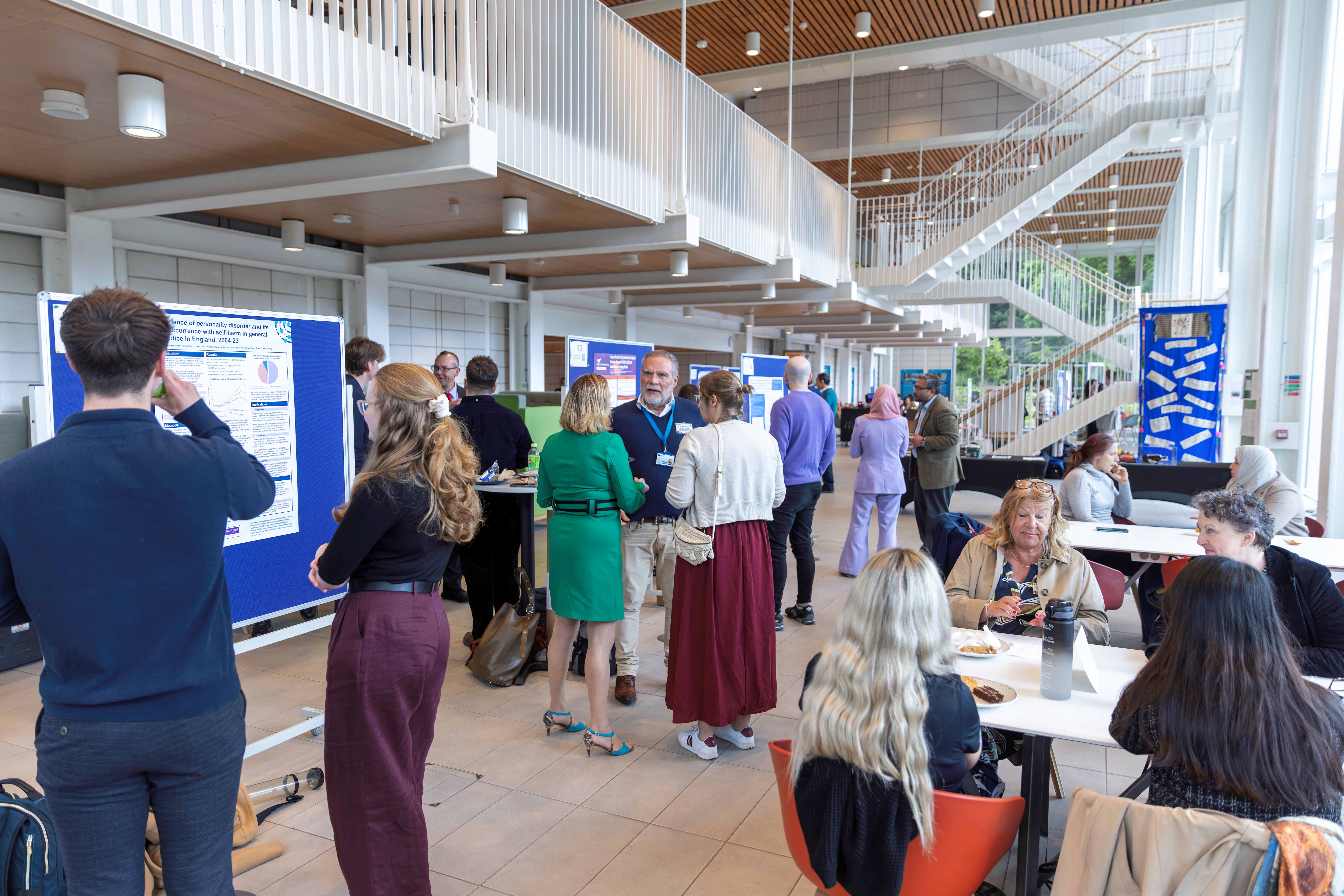
We were incredibly proud to host the Annual National Primary Care Mental Health conference this year. For the first time, the National Institute for Health and Care Research (NIHR) Mental Health Translational Research Collaboration Mission (MH-TRC Mission) and the Society for Academic Primary Care (SAPC) Mental Health Special Interest Group (MHSIG) worked collaboratively, hosting the event on 13th May 2026 at the University of Nottingham campus amongst award-winning gardens and the beautiful architectural setting of the Monica Partridge building. Professor Heike Bartel curated a unique participatory art exhibition, with artists who worked alongside people experiencing mental health challenges. The event, held within Mental Health Awareness week, received considerable social media support from key national stakeholders and policymakers, which was heartwarming.
The focus of the day was why people in underserved communities aren’t getting the access to mental health treatment and services they need, and how this can be addressed.
Historically academic conferences were places where researchers came to talk to other researchers. Perhaps the thinking and ideas were challenged but within the silo of others from a similar community. This year the conference organisers deliberately co-created friendships and relationships with people from a wide range of communities to actively co-design, co-create and participate in the conference. These conversations resulted in collaboration and will lead to new ways of thinking, seeking to learn and conducting research in the future.
We focused hard on creating a safe space for delegates and acknowledging difference. For example, we reminded delegates of the importance of psychological safety and that participants on the day may have varied identities. Demography teaches us about protected characteristics. However, historically researchers collect data which is easily available through, e.g., the Office of National statistics (ONS), which misses other identities. During the conference it was an apt reminder that there are many ways to describe our own identities, e.g. for some communities this might mean dialects of first languages spoken with family and friends, which remain undeclared on ONS surveys. Until researchers actively seek to know and understand how individuals may perceive their own identities, and seek to learn deeply how communities may have been brought together through a shared knowledge, understanding, or history, our research will miss important differences in people’s experiences.
After incredibly engaging parallel oral presentations, which resulted in four winners, we had a keynote speech from Professor Lucy Selman from Bristol. There were so many things to take away. One of the key learnings was that the UK statutory organisations often aggregate data about deprivation. Professor Selman took the time to examine publicly available data to describe household level deprivation within a short distance of our coastline. The information shown was powerful. It demonstrated that households who live close to the coast experience greater levels of socio-economic deprivation than people who live further inland. Perhaps this is common sense. Often the most groundbreaking research is stating the obvious using meticulous methodology then communicating this to wider society. Without such powerful research messages, policy is unlikely to change.
It was wonderful to see such a wide range of early career researchers, lived experience experts, clinicians and other presenters engaging in networking, including discussion about the posters. The poster award was chosen through a vote by conference delegates on the day.
During the participatory art exhibition, invited researchers and stakeholders were able to engage deeply, from the evening before the conference under the expert facilitation of Professor Bartel. Stories, feelings and experiences were generously shared through the media of: artefacts; visual stimuli; and participatory design. One of the most engaging items was a simple plait, made of string, created by a daughter to recall the memory of her mother plaiting her hair throughout childhood to ‘plait kindness and resilience’ into her through this simple daily act. The tapestry which represented concepts of resilience hung beautifully in the window with the University of Nottingham gardens visible behind it. Each time this tapestry is hung it will have a different meaning and be shown, literally, in a different light. The tapestry created by Arabic speaking women from Notts spoke strongly to the relevance of everyday items, such as buttons and the calico cotton spoke of a lengthy history of a plant which has bound together people, cultures and religions for thousands of years. Portraits of minoritised men who had spoken courageously about their eating disorders were visible from a distance. On closer engagement, the artist, Gary Dadd, had used the actual words from the interview transcripts to create the pictures. Nicola Halford, co-chair of the Mission on Mood lived experience advisory panel, generously added one of her highly reputed glass paintings to this display.
During a panel discussion, we brought together interdisciplinary perspectives from a range of backgrounds. In the panel we represented Western biomedical psychiatry, the arts and humanities, the lived experience narrative, theological perspectives, philosophy and some of the narratives in the audience, such as evolutionary psychiatry and GP chaplaincy. This discussion represented a plaiting together of multiple strands of thinking, knowing and learning through curious enquiry. The diversity of mental health support provided, often with little acknowledgement, through people working in community or religious groups and the arts, was discussed against the backdrop of new clinical initiatives such as the Nottingham Research and Advice for Depression clinics – all ultimately seeking to provide more approachable ways for people to be heard and offered care. We hope this conference initiates numerous conversations which help us to turn the problem about ‘how to address primary care mental health inequalities’ around, like turning an artefact in front of a lens. Delegates learned that being curious and sharing our ideas happens through: eating and drinking together; listening; speaking; staying silent; doing and thinking.
Our event started a rich discussion about minimum standards for inclusion and showed how ‘inclusion’ starts with an intention and an attitude but then requires time, effort and patience. We acknowledge that several participants’ voices were still absent from the conversation. We will continue to include those voices in other ways. We acknowledge that we are here today because of a history that spans back more than 40,000 years. And that disciplines, such as philosophy or evolutionary psychiatry, may help us to explore the issues in innovative ways.
The event was over in one short day. However, just two weeks after the event, we are still being touched by human connections from people who were present on the day, via emails of support or reflections on authenticity and acknowledgements of complexity. The event was successful and possible because of a network of people who wanted to make this conference possible and supported the art exhibition. A special thanks goes to Vicky Owen for her amazing attention to detail and energy. Special thanks to Becky Woodcock for helping people with lived experience feel looked after. And the whole administrative and managerial team at the University of Nottingham and Nottinghamshire Mental Healthcare Trust who supported the planning and on the day, led by Darren Wright. We would like to acknowledge the support of the NIHR MH-TRC Mission and SAPC in making this conference possible. Vibhore would like to acknowledge the mentors he has been working with from lab4living at Sheffield Hallam University as part of his NIHR senior clinical and practitioner research award. Without the support of Gemma Wheeler and Joe Langley, he may never have realised that his values, lived experience narratives and peer reviewed medical research papers could plait together through interdisciplinary perspectives. We would like to acknowledge the lived experience participants who helped to organise and contribute to the event and that some wished not to be named. We would like to acknowledge the conversations which have taken place with people who have voices that were less heard on the day and continue to hear those voices in other ways.
Well done to the winners of the prizes:
Best Oral Presentation in the Therapeutic Approaches and Workforce Capability room:
James Tawse
For the presentation on:
GPs’ experiences of moving on from patient safety incidents: a qualitative study
Best Oral Presentation in the Complex Needs and Long-Term Mental Health Conditions room:
Hannah Bowers
For the presentation on:
Long-term antidepressant use and discontinuation in the context of socioeconomic deprivation: a qualitative interview study with public involvement
Best Oral Presentation in the Access, Equity and Inclusion room:
Joanna Rutter
For the presentation on:
Women’s Lived Understandings of Suicidality: A Scoping Review of Qualitative Evidence
Best Oral Presentation in the Service Innovation and System Integration room:
Maria Kordowicz
For the presentation on:
Shared Medical Appointments in Primary Care: Harnessing the Relational in Multimorbidity Care
Best Presented Poster award went to:
Tamsin Fisher
For the presentation on:
Supporting help-seeking in farmers to prevent self-harm and suicide
Please get in touch with c.a.chew-graham@keele.ac.uk and katrina.turner@bristol.ac.uk if you would like to host the 2027 conference.